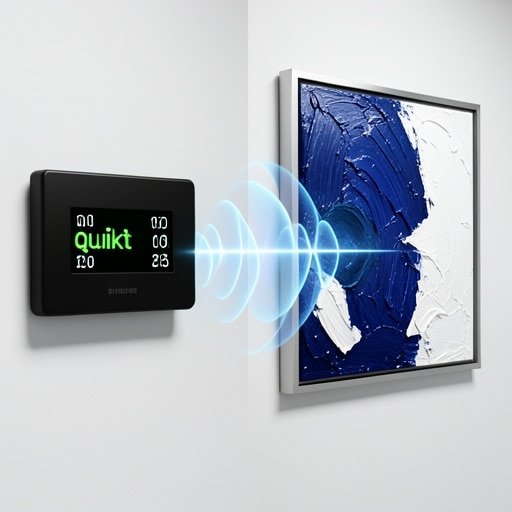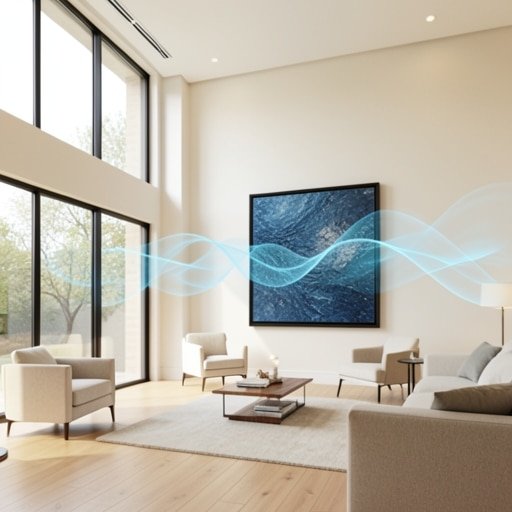

Curious about the magic behind the silence? Explore the sound absorption science that allows a beautiful painting to quiet a noisy room. We’ve all experienced it: that sharp, ringing echo in a modern living room or the distracting “clatter” of a busy office. While modern architecture loves hard surfaces, our ears do not. This is where noise reduction technology meets fine art. Understanding how acoustic panels work is the first step toward transforming your environment from an echo chamber into a peaceful sanctuary.
What is Sound Reverberation? (The Enemy of Quiet)
To solve a noise problem, you must first understand the enemy: reverberation. When sound waves travel through a room, they don’t just disappear. They hit surfaces and bounce.
How Sound Waves Bounce Off Hard Surfaces
Think of sound like a rubber ball. When it hits a hard, flat surface like a glass window, a concrete wall, or a hardwood floor, it bounces back with almost all its energy. In a room filled with these materials, sound waves bounce millions of times per second. This creates “reverb,” which makes speech muddy and increases background noise.
The Impact of “Clatter” on Our Mental Well-being
Excessive noise isn’t just annoying; it’s stressful. Persistent background echo increases cortisol levels, reduces focus, and causes “listener fatigue.” By learning how acoustic panels work, you can actively design a space that supports mental clarity and relaxation.
The Physics of Sound Absorption Science Explained
Acoustic art panels are not “sound blockers”; they are energy converters. This is the heart of sound absorption science.
Kinetic to Thermal: Turning Sound into Heat
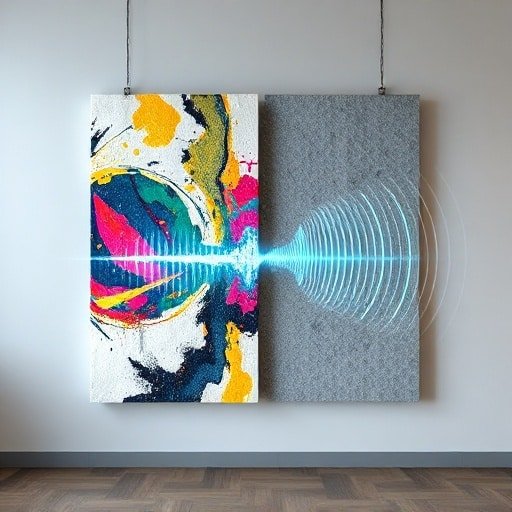
Sound is a form of kinetic energy—it’s the vibration of air molecules. When these vibrating molecules hit a porous material, they have to struggle to pass through the tiny, interconnected air pockets. This struggle creates friction. The friction converts the sound’s kinetic energy into a tiny, unnoticeable amount of thermal energy (heat). The sound wave effectively “dies” inside the panel.
The Role of Porous Materials: Trapping Vibrations in the Core
At Oilarthub, we use high-density acoustic fibers as the core of our functional art. These materials are engineered with the perfect “tortuosity”—a fancy word for a complex path that traps sound vibrations. Instead of bouncing back into your room, the noise gets lost in the maze of the panel’s core.
Why the Canvas Must Be “Acoustically Transparent”
A common question is: “Doesn’t the paint block the sound?” This is where our expertise comes in. We ensure our Hand-Painted Textured Art is created on breathable substrates. This allows sound waves to pass through the art and into the absorbing core without being reflected off the surface.
Understanding NRC Ratings: How We Measure Performance
How do we know if it’s working? We use a standardized metric called the Noise Reduction Coefficient, or NRC rating.
What Does an NRC Rating of 0.85 Actually Mean?
The NRC scale ranges from 0 (perfect reflection, like a mirror) to 1 (perfect absorption). If an acoustic art panel has an NRC rating of 0.85, it means it absorbs 85% of the sound that hits it, reflecting only 15%. Most Oilarthub acoustic panels are designed to meet or exceed this professional standard, ensuring a dramatic reduction in room echo.
Testing Standards: From the Lab to Your Living Room
These ratings are determined in reverberation chambers, testing how materials handle different frequencies, especially human speech. This data allows architects and designers to calculate exactly how many panels are needed to achieve the perfect acoustic balance in a Shop or office project.
Does Paint Texture Affect Noise Reduction Technology?
A unique feature of Oilarthub is our use of heavy impasto. Does this sculptural paint interfere with the science? Surprisingly, it helps.
Diffusion vs. Absorption: How Texture Helps Break Up Sound Waves
While the core absorbs sound, the heavy paint texture diffuses it. The uneven surface of a textured painting breaks up the sound waves and scatters them in different directions. This prevents the “standing waves” that cause the most annoying types of echoes, working in harmony with the noise reduction technology inside.
The Oilarthub Balance: Thick Impasto and High-Performance Cores
We have mastered the balance between artistic expression and acoustic physics. You get the deep, soul-stirring texture of a handmade oil painting with the high-performance silence of a professional acoustic treatment.
Conclusion: A Smarter Way to Design for Silence
How do acoustic art panels work? They work by respecting the laws of physics and the needs of the human ear. By combining sound absorption science with the timeless beauty of a textured painting, Oilarthub offers a smarter way to design. You no longer have to choose between a room that looks like a gallery and one that sounds like a library.
Don’t just take our word for it—trust the physics. Transform your space with the science of silence.