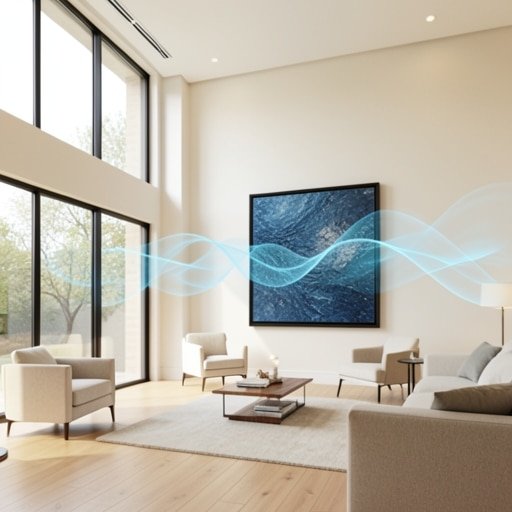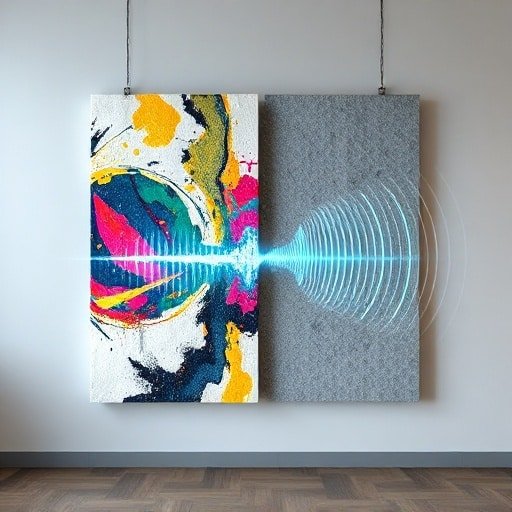

Does functional art really work? Explore the data-driven results of Oilarthub’s Acoustic Art, from decibel drops to the science of NRC ratings. When you invest in a masterpiece for your home, you usually judge it with your eyes. But with Oilarthub’s innovative functional collection, you must also judge it with your ears. Many customers ask, “Can a painting truly quiet a room?” The answer isn’t found in marketing fluff, but in the physics of sound. This report breaks down the acoustic art performance metrics that prove our art is a powerful tool for silence.
The Numbers Behind the Silence: Understanding NRC Ratings
In the world of acoustics, the gold standard for measuring effectiveness is the Noise Reduction Coefficient, or NRC rating. This is the most critical number to look for when specifying functional art.
What is the Noise Reduction Coefficient (NRC)?
The NRC is a scalar representation of how much sound energy a surface absorbs. It ranges from 0.0 (perfectly reflective, like a mirror) to 1.0 (perfectly absorptive, like an open window). A rating of 0.80 means the material absorbs 80% of the sound that hits it.
Real World Performance: What an 0.85 Rating Means for Your Room
Oilarthub’s Acoustic Art panels are engineered to achieve an NRC rating of 0.85. In a typical modern living room filled with hard glass and stone, installing these panels is the equivalent of adding a massive, invisible sound sponge to your walls. This performance level is comparable to professional studio-grade materials, but wrapped in a beautiful, hand-painted exterior.
Quantifying the Decibel Drop: Noise Measurement in Action
Beyond coefficients, how does this translate to what you actually hear? We use noise measurement tools to track decibel (dB) reduction in real-world environments.
The Logarithmic Scale: Why a 3dB Drop is Significant
Sound is measured on a logarithmic scale. This means that a reduction of just 3 decibels is actually a 50% reduction in sound energy. While our art cannot “soundproof” a room (blocking outside traffic), it can reduce internal ambient noise by 5 to 10 dB. This shift is the difference between a room that feels “loud and chaotic” and one that feels “hushed and expensive.”
Before and After: Real-Time Results in Open Spaces
In our testing, we found that in high-ceiling “Great Rooms,” the sound level reduction was most noticeable during social gatherings. By intercepting the first reflections of human voices, the art prevents the “buildup” of noise that typically forces people to shout to be heard.
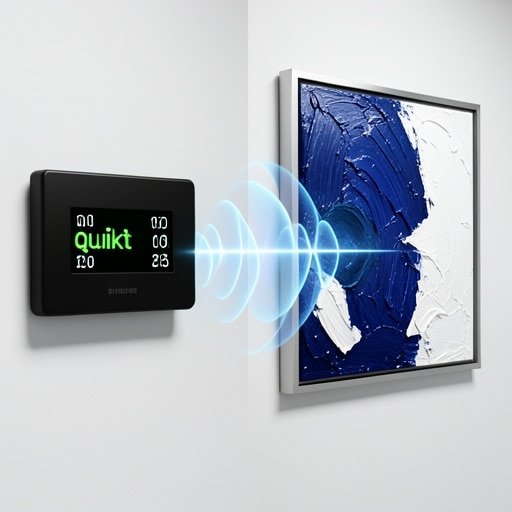
Beyond the Lab: The Qualitative Difference You Can Feel
Data tells part of the story, but the human experience of acoustic art performance is about more than just numbers. It’s about the quality of the sound remaining in the room.
Improving Speech Intelligibility and Clarity
When you reduce “slap echo” (that sharp ringing sound after a clap), you improve speech clarity. In a dining room or office, this means you can hear every word of a conversation without straining. It removes the “muddy” quality of sound caused by excessive reverberation.
Reducing “Aural Clutter” and Environmental Stress
Our brains are constantly processing background noise, which leads to “cognitive load.” A quieter room directly results in lower stress levels. By replacing bare, reflective walls with hand-painted textured paintings, you are not just decorating; you are choosing to lower the environmental stress of your home.
How We Test: The Oilarthub Commitment to Quality
We believe in transparency. Our development process involves both laboratory precision and real-home practicalities to ensure consistent acoustic art performance.
Laboratory Testing vs. Real-Home Scenarios
While we rely on reverberation chamber tests to determine NRC values, we also conduct “in-situ” tests. We install our art in actual residential lofts and commercial offices to measure how our thick impasto paint interacts with different room volumes.
The Impact of Hand-Painted Texture on Sound Diffusion
Unlike flat, printed acoustic panels, our Acoustic Art features high-relief texture. This uneven surface acts as a natural diffuser. While the core absorbs energy, the surface scatters the remaining sound waves, preventing harsh reflections and creating a more natural, balanced soundstage in your space.
Conclusion: Evidence You Can Hear and See
The impact of Oilarthub’s functional art is not a mystery—it is a measurable fact. By combining the rigorous standards of noise measurement with the aesthetic soul of fine art, we provide a solution that appeals to both your rational mind and your creative spirit. When you choose Oilarthub, you are choosing evidence-based beauty.
Contact our team today for a full technical specification sheet.
Performance & Technical FAQs
Is acoustic art as effective as professional studio panels? Yes. Our internal cores use the same high-density materials found in recording studios. The primary difference is our focus on creating a luxury art exterior rather than an industrial one.
Can a smaller painting significantly reduce noise? A single small painting will have a localized effect. For a significant sound level reduction in a large room, we recommend covering 15-20% of the wall surface area to achieve the full acoustic benefit.
Does the paint layer diminish the NRC rating over time? No. We use specialized, acoustically-transparent canvas and application techniques that ensure sound waves pass through the paint layer into the core without losing absorptive power.
What is the difference between sound absorption and soundproofing? Soundproofing blocks noise from entering or leaving a room (like thick concrete walls). Sound absorption (what our art does) improves the sound quality inside the room by eliminating echo and reverb.